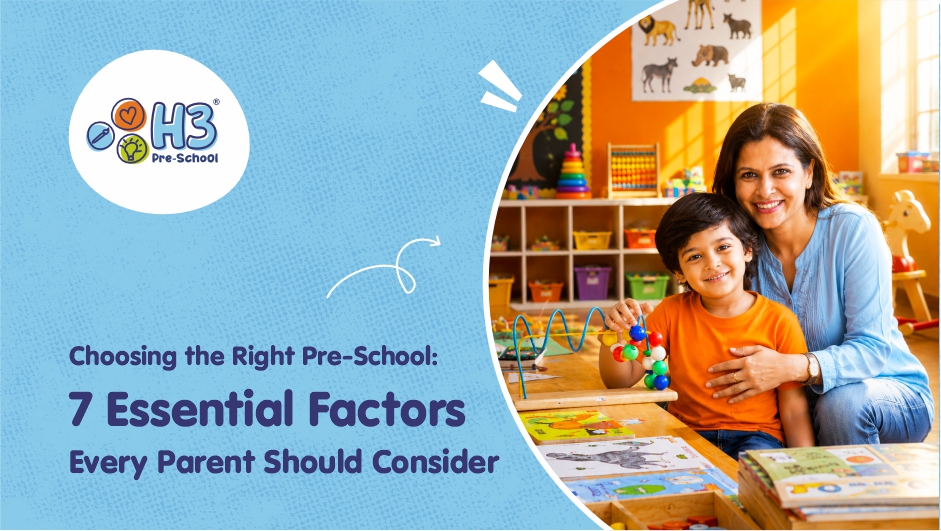
Choosing the Right Pre-School: 7 Essential Factors Every Parent Should Consider
The early years of a child’s life lay the foundation for their future learning, behavior, and development. Choosing the right preschool is one of the most important decisions parents make, as it is often the first environment where a child steps outside the comfort of home and begins exploring the world independently.
But how do you identify the right preschool for your child? Here are seven key factors every parent should consider.
Choosing the Right Preschool: A Guide for Parents
A preschool is much more than a place where children learn their ABCs and numbers. It is a child’s first step towards independence, social interaction, and holistic development. The right Pre-School creates a safe, nurturing, and stimulating environment where children can thrive emotionally, physically, socially, and intellectually.
1. Convenient Location Matters
One of the first things to consider is the location of the preschool. A preschool that is close to home offers convenience and peace of mind. Since it is often a child’s first experience away from home, parents should be able to reach their child quickly in case of emergencies or unforeseen situations.
A nearby preschool also reduces travel fatigue for young children and helps them maintain a comfortable daily routine.
2. A Home Away From Home
Children adjust best in environments that feel warm, welcoming, and familiar. The ideal preschool should feel like a second home where children are cared for with love and patience.
From teachers and support staff to security personnel, everyone should contribute to creating a nurturing atmosphere. A caring environment helps children settle in comfortably and build trust, making the transition from home to school smoother and less stressful.
3. Safety and Hygiene Should Be Non-Negotiable
Safety is one of the most critical aspects of a preschool.
Parents should look for features such as:
- Fire safety measures and emergency preparedness
- Child-friendly furniture with rounded or foam-covered edges
- Safe and well-maintained play areas
- Clean and hygienic washrooms
- Regularly disinfected activity zones, including sand play areas
- Clutter-free premises with no hazardous materials
- Adequate greenery and well-maintained surroundings
A safe environment allows children to explore confidently while giving parents peace of mind.
4. Importance of a Well-Designed Play Area
Play is not merely recreation; it is an essential part of childhood development.
A quality preschool should offer age-appropriate play equipment that supports gross motor skill development, coordination, balance, and social interaction. Playgrounds also encourage children to make friends, learn teamwork, and develop confidence.
Green spaces and natural surroundings further enhance the learning experience by connecting children with nature.
5. A Curriculum That Encourages Exploration
At the preschool stage, learning should not revolve around excessive teaching, worksheets, or rote revision.
Instead, the curriculum should focus on exploration, creativity, and discovery. Every child possesses unique interests and talents, whether in sports, arts, academics, music, or problem-solving. A good preschool provides opportunities for children to identify and nurture these natural abilities.
The goal should be to develop curiosity and a lifelong love for learning rather than simply preparing children for examinations.
6. Learning Beyond the Classroom
Field trips, community visits, and role-play activities play a vital role in a child’s understanding of the world.
When children interact with farmers, shopkeepers, doctors, firefighters, gardeners, and other community helpers, they develop empathy, respect, and appreciation for the efforts of others.
For example, when children learn how fruits and vegetables are grown, they begin to value food and understand the hard work behind it. Such real-world experiences make learning meaningful and memorable.
7. Limited Screen Exposure and Real-Life Learning
In today’s digital world, it is important for preschools to maintain minimal screen exposure.
Young children learn best through direct experiences, hands-on activities, storytelling, conversations, and interaction with their surroundings. Learning materials should be relatable and connected to the child’s real environment.
For instance, if a child learns about a cow from a picturebook, it should resemble the cows they commonly see around them. Familiar and culturally relevant examples help children build stronger connections with what they learn.
Creating a Holistic Environment for Growth
The best preschool is one that nurtures every aspect of a child’s development, emotional, physical, social, and intellectual. It provides a balance of safety, care, exploration, play, and meaningful learning experiences.
As the saying goes, children don’t do what you say; they do what you do. A preschool should therefore model positive values, curiosity, empathy, and respect through everyday experiences.
When children grow in a holistic environment, they don’t just learn—they flourish.
This version is suitable for a preschool website, parenting blog, newsletter, or admission campaign.
Frequently Asked Questions (FAQs)
Q1. What is the ideal age to start preschool?
Most children begin preschool between the ages of 2 and 4 years, depending on their developmental readiness.
Q2. How do I choose the right preschool for my child?
Parents should evaluate safety, curriculum, teacher qualifications, learning environment, communication practices, and overall reputation.
Q3. Why is preschool important for child development?
Preschool helps children develop social, emotional, cognitive, communication, and problem-solving skills that support future academic success.
Q4. What should parents look for during a preschool visit?
Parents should assess cleanliness, safety measures, teacher-child interactions, learning resources, and the overall atmosphere.
Q5. How important is play in preschool education?
Play supports creativity, physical development, social skills, confidence, and emotional growth, making it a crucial part of early childhood education.
Schedule a Visit to H3 Preschool
Choosing the right preschool is one of the most important decisions for your child’s future.
✓ Explore our learning environment
✓ Meet our educators
✓ Understand our learning approach
✓ Experience our child-centric programs
Contact H3 Preschool today to schedule a visit and discover how we help children learn, grow, and thrive.
Reviewed By
Mr. Rinkukumar N. Vyas
Chief Operating Officer, H3 Preschool
With extensive experience in educational operations and child-centric learning environments, Mr. Vyas helps ensure that H3 Preschool maintains high standards in early childhood education and student development.