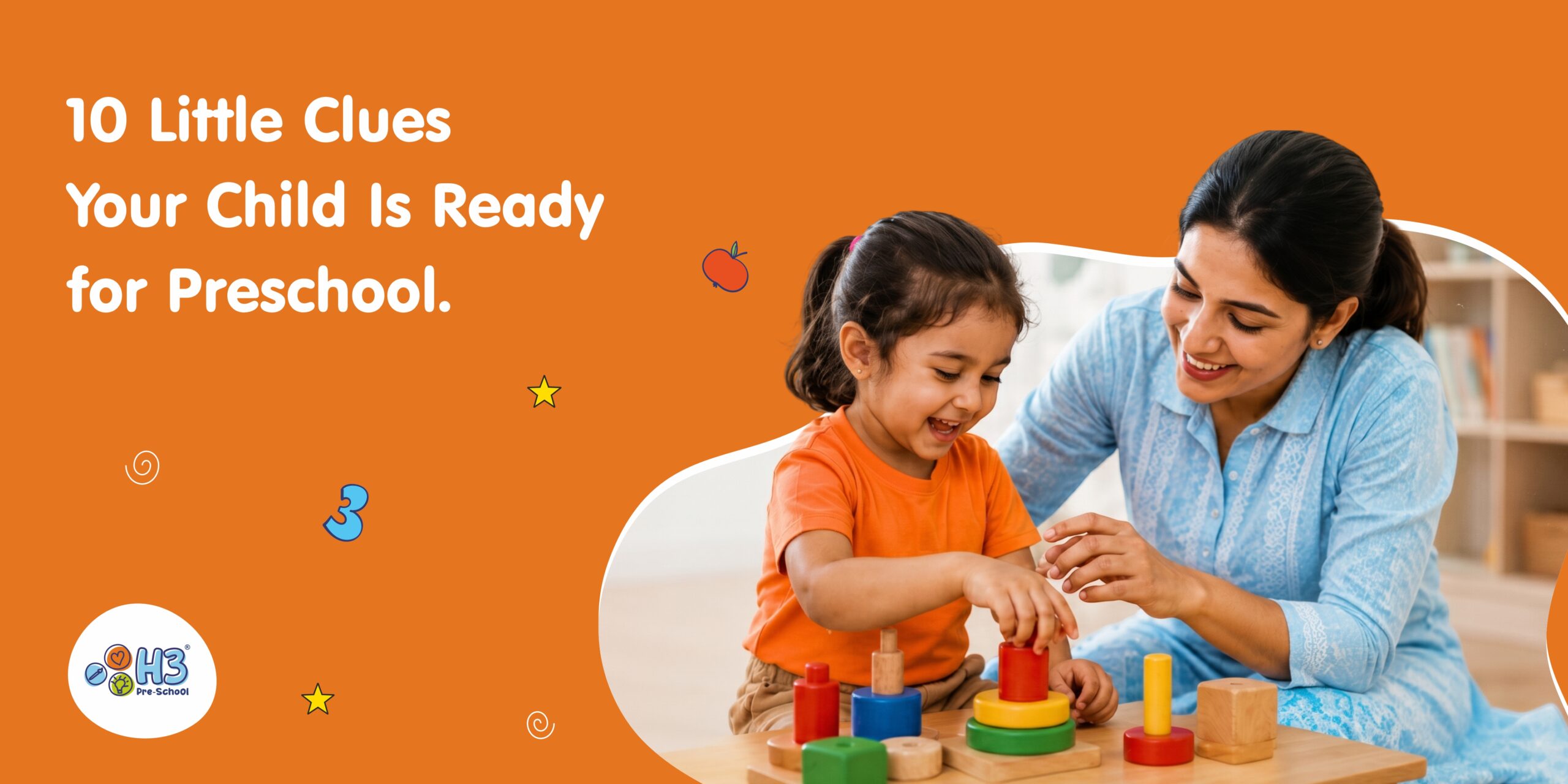
10 Signs Your Child Is Ready for Preschool
As a parent, one of the most meaningful milestones you will witness is watching your child grow from a curious toddler into a confident little learner. But how do you know when the time is right to take that next step and enrol your child in preschool? The answer lies not just in age, but in your child’s overall developmental readiness.
Every child is unique. While most children begin their preschool journey between the ages of 2.5 and 4 years, the true markers of readiness go far beyond a birthday. Preschool readiness is about emotional, social, physical, and cognitive growth — and your child often shows you the signs long before you realise it.
Parents searching for the best preschool in India or exploring a nursery school in India frequently ask: “Is my child ready?” This guide outlines 10 clear signs your child is ready for preschool, helping you make a confident and informed decision as you explore preschool admission options.
Why Recognising Readiness Matters
Starting preschool at the right time can make a significant difference in how smoothly and happily your child adjusts to their new learning environment. A child who is emotionally and socially prepared tends to engage more readily, form friendships more easily, and develop a genuine love for learning from the very beginning.
Rather than waiting for a specific age, observe your child’s behaviour, responses, and daily habits. These will tell you far more than any calendar can.
10 Signs Your Child Is Ready for Preschool
1. Your Child Shows Interest in Other Children
One of the earliest and clearest signs of preschool readiness is when your child begins showing genuine interest in other children. If your little one watches other kids at the playground, tries to join in their games, or eagerly asks about having friends to play with, they are demonstrating an important readiness for social interaction. Preschool provides a structured environment where children learn to build relationships, cooperate, share, and develop the social skills that form the foundation of lifelong friendships.
2. Your Child Can Communicate Basic Needs
Your child does not need to speak in complete sentences, but the ability to express basic needs clearly is an important milestone. If your child can say “I am hungry,” “I need to use the bathroom,” or “I want to play,” they have developed the communication skills needed to navigate a preschool classroom. Strong language development at this stage helps children feel understood, reduces frustration, and enables them to participate meaningfully in learning activities.
3. Your Child Has Basic Self-Help Skills
Simple acts of independence — washing hands before meals, carrying their bag, attempting to put on shoes, or tidying up their toys — are strong indicators of preschool readiness. These self-care skills help children feel confident and capable in a group setting. Preschool encourages children to develop greater independence every day, and children who already have a foundation of basic self-help skills tend to settle in more comfortably.
4. Your Child Can Manage Short Separations
A little separation anxiety is completely normal and expected. However, if your child can spend a few hours comfortably with a grandparent, relative, or caregiver without prolonged distress, they are developing the emotional readiness needed for preschool. Managing short separations is a key developmental milestone. It does not mean your child will not miss you — they will! — but being able to settle, engage, and enjoy time away from home is an encouraging sign that preschool drop-off will be a positive experience.
5. Your Child Shows Curiosity and a Love for Exploration
Does your child constantly ask “Why?” Do they love to explore, touch, observe, and discover? Natural curiosity and a genuine enthusiasm for new experiences are among the most positive indicators of school readiness. Preschool is designed around play-based learning that channels a child’s natural curiosity into meaningful discovery. A child who approaches the world with wonder is perfectly suited to thrive in a well-designed early childhood education environment.
6. Your Child Can Follow Simple Instructions
Throughout the preschool day, teachers give clear and gentle directions — “Please sit in a circle,” “Put your crayons away,” “It is time for snack.” A child who can listen to and follow two-step instructions at home is already well prepared for a structured classroom environment. This ability reflects healthy development in attention span, listening skills, and self-regulation — all of which support a smooth and successful preschool transition.
7. Your Child Has a Stable Daily Routine
Children who feel secure within a predictable daily routine — waking up, mealtimes, playtime, and rest — often adapt more easily to the rhythm of preschool life. A consistent routine at home naturally prepares children for the structured preschool schedule of circle time, learning activities, outdoor play, and snack breaks. If your child thrives with predictability and knows what to expect each day, preschool’s familiar rhythm will feel comforting rather than overwhelming.
8. Your Child Is Toilet Trained or Nearing Readiness
Most preschool programmes in India require children to be toilet trained, or at least well on their way. If your child can recognise the urge to use the bathroom and communicate this need to an adult, they are meeting an important practical milestone for preschool admission. Accidents do happen, and experienced preschool teachers handle them with care and warmth. However, a degree of toilet independence helps children feel more confident and comfortable in a group setting.
9. Your Child Shows Emotional Awareness
When your child begins to name their feelings — “I feel sad,” “That made me angry,” or “I am happy today” — they are developing emotional literacy, a skill that is central to success in preschool. Social-emotional learning is at the heart of quality early childhood education. A child who can begin to recognise and express their emotions is better equipped to build meaningful friendships, handle small conflicts, and develop the emotional resilience they will rely on throughout their school journey.
10. Your Child Expresses Excitement About New Experiences
Perhaps the most delightful sign of all — when your child points at a school bus with excitement, asks to visit a classroom, or says “I want to go to school!” — they are telling you something important. An eagerness for new experiences, new people, and new environments is a wonderfully positive sign of preschool readiness. A child who approaches new situations with openness and enthusiasm is ready to flourish in a nurturing preschool environment that celebrates discovery, creativity, and growth.
Is Meeting Every Sign Necessary?
Not at all. Very few children will demonstrate all ten signs at the same time. These indicators are meant to guide and reassure you, not to create a checklist that must be completed before your child can begin their preschool journey.
Parents should avoid comparing their child with others and instead focus on individual growth and readiness. The goal is not to start early for the sake of it, but to begin when your child is emotionally, socially, and developmentally prepared to benefit from the experience.
How Parents Can Support Preschool Readiness
There are several simple and meaningful ways to help your child feel confident and excited about starting preschool:
- Establish a consistent daily routine at home
- Encourage independent play and simple responsibilities
- Read books together to build language and vocabulary
- Arrange regular playdates to promote social interaction
- Visit the preschool campus before the first day
- Talk about preschool in a warm, positive, and exciting way
- Practise short separations with trusted family members
These small, intentional steps can make a meaningful difference in how smoothly your child transitions into their new early learning environment.
Why the Right Preschool Environment Matters
Recognising your child’s readiness is only one part of the equation. Equally important is choosing a preschool environment that will nurture, support, and celebrate your child’s unique development. Parents looking for the best preschool in India should look beyond academics and focus on programmes that offer holistic development.
When evaluating preschool admission options, consider:
- Safe, hygienic, and child-friendly facilities
- Qualified, experienced, and caring educators
- An age-appropriate, play-based curriculum
- Opportunities for holistic development
- Strong and transparent parent-school communication
- A warm, inclusive, and nurturing classroom environment
A quality preschool does more than teach letters and numbers. It builds confidence, curiosity, creativity, and emotional intelligence — qualities that support children throughout their entire educational journey.
Final Thoughts
Every child’s journey to preschool is unique, and there is no single right moment that applies to every family. By observing your child’s development and recognising the signs of preschool readiness, you can make a thoughtful and confident decision about when to begin their early childhood education.
When the time feels right, choosing a nurturing, development-focused preschool will ensure that your child’s first steps into formal learning are filled with joy, discovery, and a genuine love for school.
Frequently Asked Questions
Q.1 What are the most important signs that a child is ready for preschool?
Key signs include the ability to follow simple instructions, interest in social interaction, basic self-help skills, curiosity, and the ability to manage short separations from parents.
Q.2 Does my child need to show all 10 signs before starting preschool?
No. These signs are guidance indicators, not a mandatory checklist. Most children will show several signs at a time. Focus on your child’s overall readiness rather than a perfect score.
Q.3 What is the ideal age to begin preschool admission in India?
Most children begin preschool between the ages of 2.5 and 4 years. The right age depends on each child’s individual developmental readiness rather than a fixed number.
Q.4 How can I help my child prepare emotionally for preschool?
Establish a daily routine, practise short separations with trusted caregivers, read books about starting school, visit the preschool beforehand, and talk positively about the upcoming experience.
Q.5 What should I look for when choosing the best preschool in India?
Look for safe and hygienic facilities, qualified educators, a play-based and age-appropriate curriculum, strong parent communication, and a nurturing environment that supports holistic child development.
Reviewed By
Mr. Rinkukumar N. Vyas
Chief Operating Officer, H3 Preschool
With extensive experience in educational operations and child-centric learning environments, Mr. Vyas helps ensure that H3 Preschool maintains high standards in early childhood education and student development.