
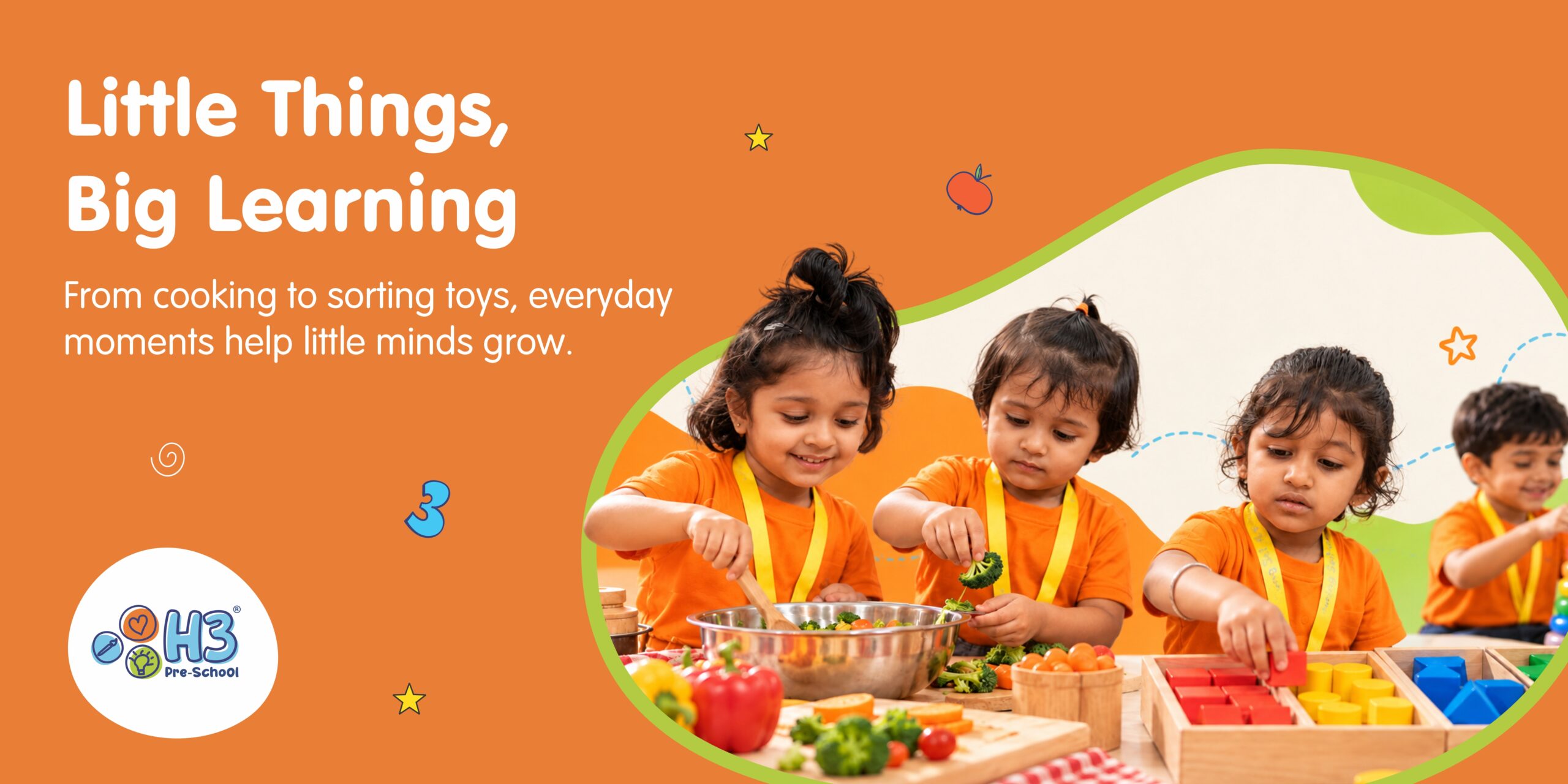
Learning Through Everyday Activities: From Cooking to Sorting Toys
Introduction
Some of the best learning moments happen outside a classroom. They happen when children help in the kitchen, put their toys away, water a plant or set the table for a meal. These everyday activities may seem simple, but they give young children plenty of opportunities to explore, think and learn.
For preschoolers, learning is not just about books, numbers and letters. It is also about understanding the world around them, trying new things and becoming more independent. With a little guidance from parents, everyday routines can become meaningful learning experiences.
1. Cooking Together: Learning Beyond the Kitchen
The kitchen can be a wonderful place for children to learn. Simple activities like washing vegetables, mixing ingredients or counting fruits help introduce early learning concepts in a natural way.
For example, asking your child to count three apples or identify the colour of a capsicum helps build number recognition and observation skills. Talking about ingredients also introduces new words and encourages children to ask questions.
Cooking together can also teach patience, following instructions and the importance of hygiene. Always choose age-appropriate tasks and supervise children closely, keeping them away from hot surfaces, sharp tools and other kitchen hazards.
A simple activity to try: Ask your child to help arrange fruits on a plate. Count them together, name their colours and talk about their shapes.
2. Sorting Toys: Making Learning Fun
Tidying up after playtime does not have to feel like a chore. It can become a fun activity that helps children develop important early learning skills.
Encourage your child to sort toys by colour, shape, size or type. They could put all the building blocks in one basket, soft toys in another and toy cars in a separate box.
This simple activity introduces children to sorting, grouping and comparing. It also helps develop logical thinking, attention to detail and problem-solving skills.
As children grow more comfortable with sorting, you can make the activity slightly more challenging by asking questions such as, “Which group has more toys?” or “Can you find all the red blocks?”
A simple activity to try: Turn cleanup time into a sorting game. See how many toys your child can put in the right basket before a favourite song ends.
3. Setting the Table: Building Early Maths Skills
Everyday tasks like setting the table offer children a chance to practise counting and matching while learning to contribute to family routines.
Ask your child to place one spoon beside each plate or count how many family members will be eating. These small tasks help children understand numbers, quantities and one-to-one correspondence.
They also encourage responsibility and give children a sense of belonging. When children feel trusted to help with simple tasks, they become more confident in their abilities.
A simple activity to try: Ask your child to count the people at the table and help place the same number of napkins. Use child-safe items and supervise as needed.
4. Watering Plants: Discovering the World Around Us
Children are naturally curious about the world around them. Caring for a plant gives them an opportunity to explore nature and understand how living things grow.
Let your child help water a plant, observe its leaves or notice a new flower. Talk about what plants need to grow, such as sunlight, water and care.
These activities encourage observation, curiosity and a sense of responsibility. Over time, children may begin to notice changes in their surroundings and ask questions about why they happen.
A simple activity to try: Choose a small plant and observe it together every few days. Ask your child what looks different and encourage them to describe what they see.
5. Folding Clothes: Understanding Sizes and Patterns
Even folding laundry can become a learning opportunity. Children can help match pairs of socks, group clothes by colour or identify which items belong to them.
Matching socks encourages visual recognition, while grouping clothes introduces patterns, similarities and differences. Folding small towels or handkerchiefs also helps children practise coordination and follow simple instructions.
The aim is not to make every fold perfect. It is to give children the freedom to try, learn and improve with practice.
A simple activity to try: Mix a few pairs of socks and ask your child to find the matching ones. Make it more interesting by discussing their colours and sizes.
6. Everyday Conversations: Learning Through Words
Learning does not always require a planned activity. Sometimes, a simple conversation can be just as valuable.
Talk to your child while walking to school, shopping for groceries or getting ready for bedtime. Ask open-ended questions like, “What was your favourite part of today?” or “What do you think will happen next?”
These conversations help children develop vocabulary, listening skills and the confidence to express their thoughts. They also teach children that their ideas and observations matter.
Give them time to answer, listen patiently and build on what they say. There is no need to rush the conversation or turn it into a test.
How Parents Can Make Everyday Learning More Meaningful
Children learn best when they feel comfortable, supported and free to explore. Here are a few simple ways to make everyday activities more effective:
-
Keep it playful: Turn tasks into games instead of making them feel like lessons.
-
Encourage independence: Let children try things on their own, with age-appropriate support.
-
Ask questions: Help them think, observe and find answers rather than giving every answer immediately.
-
Appreciate the effort: Focus on their willingness to try, not just on getting things right.
-
Be patient: Children learn at different paces. Give them time to practise and improve.
-
Make it part of the routine: Regular opportunities to participate help children build confidence and familiarity.
Remember, the goal is not to make every moment educational. It is to recognise that children are learning all the time, often through the simplest experiences.
Conclusion
From counting fruits in the kitchen to sorting toys after playtime, everyday activities offer countless opportunities for children to learn naturally. These experiences help build early maths and language skills, encourage curiosity, develop coordination and nurture independence.
At H3 Preschool, we believe that meaningful early learning goes beyond worksheets and structured lessons. It grows through exploration, hands-on experiences, interaction and the freedom to discover something new every day. As a preschool committed to creating meaningful learning experiences, H3 Preschool aims to give children a strong foundation for their future, making it a choice for parents looking for the Best Preschool in Gujarat.
Because sometimes, the little things children do today become the building blocks for the big things they learn tomorrow.


